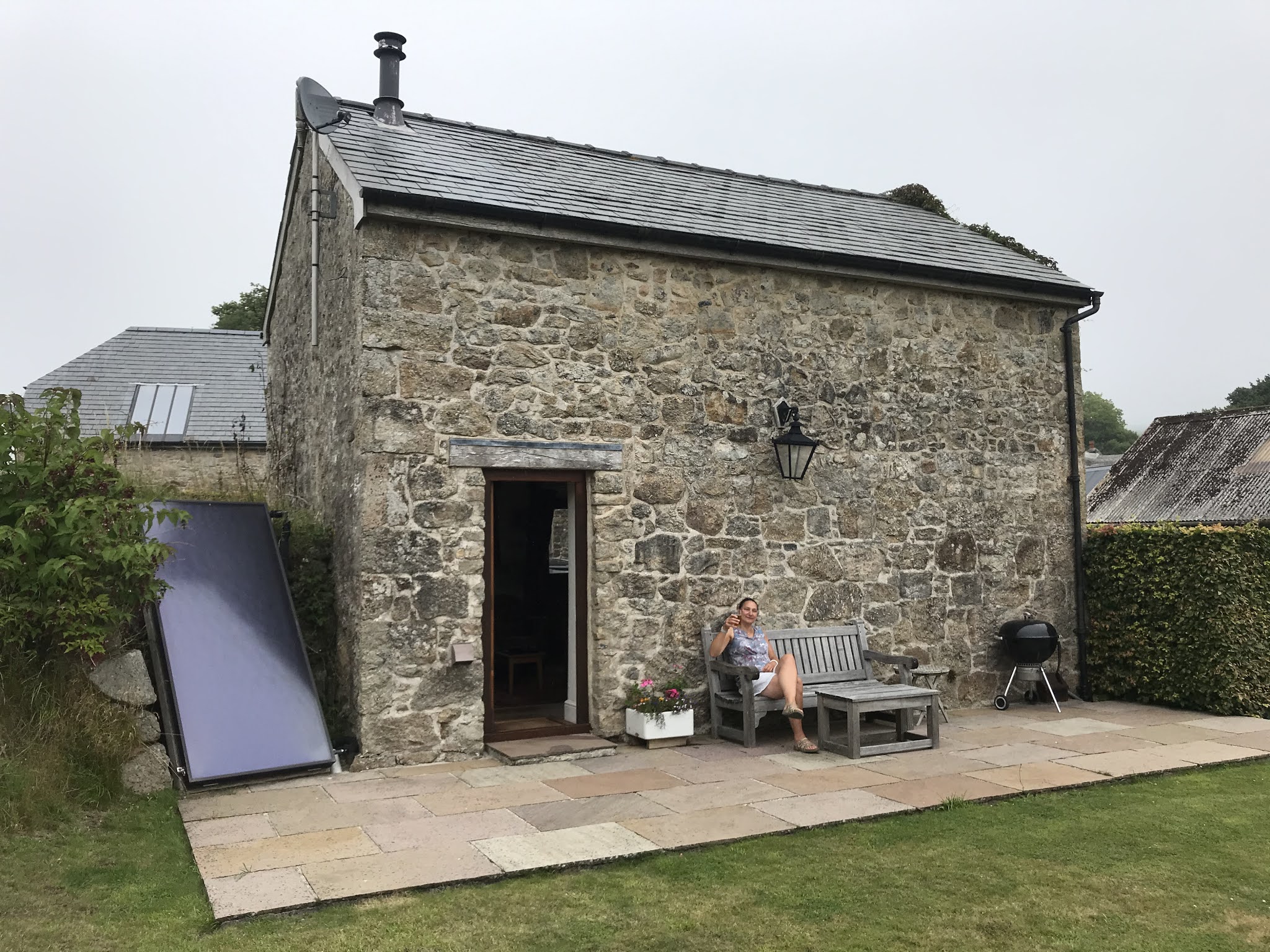
Prior to our trip, I had checked in with the owners of Widecombe Cottage and confirmed that I could bring the 20W actinic Skinner trap. The garden of the cottage being discreet with any night-lights not affecting the nearby cottages.
On arrival we discovered that Becks and Richard had thoughtfully provided an extension lead from the barn, so that I could have mains power without the need to leave the back door of the cottage ajar overnight.
Over the week we ran four moth trap sessions - the first and the last being the most productive of the quartet.
 |
Widecombe Cottage, Lower Venton Farm
|
The first night's trap, was opened and emptied on the morning of the 1st August. R had joined us for the day - so we emptied the trap together, potted everything we could catch, noted the escapes; before heading out for the day, having left the pots stacked carefully for processing on our return.
Our first day's outing comprised a walk along Dr Blackall's Drive between Aish Tor and Mel Tor (return). The short walk was notable for a male redstart - foraging with stonechat and meadow pipit along the low stone walls near Aish Tor.
However, the best birding was to be the fly-past of osprey and hobby - both occurring within minutes of each other. We had been watching the redstart - when I noticed a large bird head over the brow of Aish Tor - against the light, and with nothing to compare its size too - I momentarily mistook it for a large gull, but as it turned into the wind - it jumped out as an osprey. R was able to get some photographs of it as it headed North West following the valley and the River Dart towards Dartmeet.
 |
Osprey courtesy R.
|
Moments after the Osprey had gone from sight - the hobby appeared - and it too flew up the valley towards Dartmeet.
As we approached Mel Tor - my memory jogged, and we searched the Tor summit rocks for the natural rock basins caused by the erosion / dissolving action of water and ice on softer granite.
Returning to Aish Tor - we descended the slopes to an area of bracken and bramble criss-crossed with pathways, in the hope of securing a glimpse of high brown fritillary. Unfortunately the weather was against us, overcast and cool - when the sun did briefly appear in a random open sky - at least three fast-flying frits belted past us, but they were way too mobile for a successful identification.
The weather conditions also severely reduced our chances of seeing
Eristalis cryptarum - but we checked out the local site just in case of a break, and although unsuccessful - filed the location away for a future Dartmoor trip.
That evening whilst enjoying a couple of pints in the garden of the Rugglestone Inn a peregrine flew over heading south.
Our four moth trap sessions over the week resulted in 151 moths of 47 species, with some being new to A and I - a few of the highlights were as follows:




_front%20garden%20(1).JPG)